Most crossbows now come with a scope in the box, so the real question is usually whether the one you have is good enough, and what to buy if it isn’t. This guide explains what makes a crossbow scope different from a rifle scope, how to choose one, how to sight it in, and four scopes worth a look at different prices.
We haven’t tested these scopes ourselves. Specs come from the makers’ own product pages and manuals. Stock was checked on Amazon on October 4, 2026, and it changes often.
Do you need a crossbow scope?
You need some kind of sight, and for most hunters a scope is the best choice. A crossbow arrow drops a lot more than a bullet, so a crossbow sight needs separate aiming points for different distances. A good crossbow scope gives you those points, plus some magnification and better light in the first and last minutes of the day, when deer move most.
Your options are:
- Red dot or multi-dot sight: no magnification, fast to aim, fine for shots out to about 30 yards. Many budget crossbows come with one.
- Crossbow scope: usually 3x to 5x, with a reticle made for crossbow arrows. This is what most hunters should use.
- Rangefinding scope: measures the distance and shows you the right aiming point. Very easy to use, but heavy and expensive.
If your crossbow came with a scope that holds its zero, is clear enough to see a deer at dusk, and has aiming points that line up with where your arrows land, keep it. Upgrade if it won’t hold zero, is too dim at first and last light, or its aiming points don’t match your bow’s speed.
How a crossbow scope differs from a rifle scope
- Aiming points: a crossbow reticle has several horizontal lines or dots, usually 10 yards apart, so you can aim for 20, 30, 40 yards and beyond without guessing.
- Speed calibration: those aiming points only work if they match your arrow speed. Some scopes are made for one speed. Others let you set your bow’s speed on the magnification ring.
- Short-range settings: crossbow scopes have parallax and focus set for typical crossbow distances (Hawke’s are fixed at 50 yards, Vortex’s at 75) rather than rifle ranges.
- Built for crossbow shock: a crossbow jolts a scope differently from a rifle, so makers build their crossbow scopes to handle that. Don’t swap in a cheap rifle scope and expect it to hold its zero.
How to choose a crossbow scope
Magnification
Most crossbow shots at deer are inside 40 yards, so you don’t need much. A fixed 3x or 4x scope is plenty. A low-power variable, such as 1.5-5x or 2-7x, is useful if you also practice farther out. The old version of this article mentioned scopes up to 32x. Ignore that: high magnification narrows your view and darkens the image, which is the opposite of what you want at dusk. On many crossbow scopes, the magnification ring is also the speed setting, so you leave it in one position once the scope is set up.
Reticle and speed range
This matters more than anything else. Look up your crossbow’s rated speed with the arrows you shoot, then pick a scope whose speed range covers it. A scope made for 340 fps won’t give accurate long-range aiming points on a 420 fps bow. If your bow is very fast, a scope that adjusts up to 425 or 450 fps is the safer choice.
Illumination
Red or green illumination makes the reticle easier to see against dark timber at dawn and dusk. Turn it down to the lowest level you can see, or it will glare. Some places have rules about lighted or electronic sights, so check your state’s regulations before you hunt with one.
Tube size and rings
Crossbow scopes use 1-inch or 30 mm tubes, and the rings must match. Some scopes come with rings, but many don’t. Check before you order, and make sure the rings fit your crossbow’s rail (most are Picatinny or Weaver).
Durability and warranty
Look for a scope that’s waterproof, fogproof and nitrogen-purged, with a warranty you can actually use. Hawke has a no-fault lifetime warranty on these models, and Vortex’s warranty is unlimited and unconditional. If you buy from a third-party seller, check that the warranty still applies.
How to sight in a crossbow scope
- Mount it solidly. Tighten the rings evenly and set the scope so you get a full view with your cheek on the stock.
- Set the speed. If the scope has a speed setting, start at your crossbow’s rated speed with your arrows.
- Zero at the distance the manual gives. It varies: Hawke’s XB scopes use a 20-yard zero, the XB1 manual calibrates the speed at 30 yards, and the Vortex uses 40 yards. Shoot three-arrow groups from a rest and adjust the turrets.
- Check every aiming point. Shoot at each distance you might hunt. If the lower points hit high or low, adjust the speed setting as the manual explains, not the turrets.
- Use your hunting arrows. Practice with arrows and points of the same weight as your hunting setup. A broadhead can hit a little differently from a field point, so shoot one before the season.
Our crossbow bolts guide explains arrow weight and nocks, and our guide to crossbow accuracy covers the other things that move your arrows around.
Four crossbow scopes worth a look
All four were in stock new on Amazon when we checked:
- Best budget pick: Hawke XB 3×32 SR. Simple fixed 3x for bows near 340 fps, under $100.
- Best value: Hawke XB1 1.5-5×32 SR. Adjusts for 250 to 425 fps, under $200.
- Best overall: Vortex Crossfire II 2-7×32 Crossbow Kit. Covers 275 to 450 fps, rings included, under $200.
- Easiest to use: Garmin Xero X1i. Measures range and shows the aiming point, over $1,000.
1. Hawke XB 3×32 SR: best budget pick
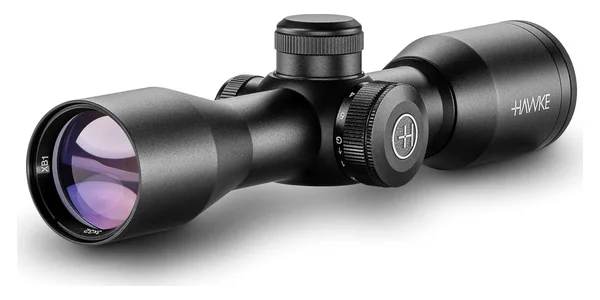
This is a simple fixed-power scope. Hawke calibrates it for 340 fps, with a 20-yard zero and aiming points every 10 yards out to 70 yards. The reticle has red or green illumination with five brightness levels, and a bracket that measures 17 inches, about the depth of a typical whitetail’s chest, to help you judge distance. It has a 1-inch tube, weighs 11 oz, and is 8.5 inches long.
The fixed calibration is the catch. It suits crossbows that shoot near 340 fps. On a much faster bow, the lower aiming points won’t line up. Rings aren’t included. It was sold by a third-party seller and shipped by Amazon, with 15 left.
2. Hawke XB1 1.5-5×32 SR: best value
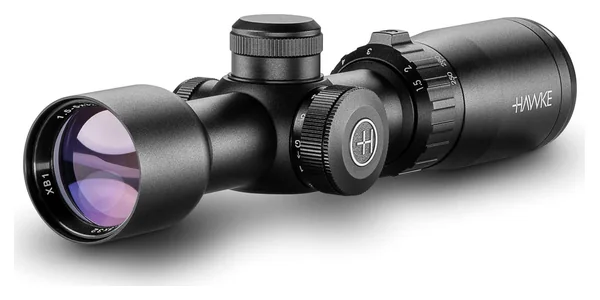
The XB1 fixes the 3×32’s main limit. Its magnification ring doubles as a speed selector from 250 fps (at 1.5x) to 425 fps (at 5x), so it can match almost any modern crossbow. The reticle has illuminated aiming points out to 60 yards and unlit marks from 70 to 100 yards. Hawke’s manual has you calibrate at 30 yards, after which the other points should line up as long as you leave the ring alone. It has a 1-inch tube, weighs 13 oz and is 8.3 inches long.
Rings aren’t included with this listing. It was sold by a third-party seller and shipped by Amazon, with 11 left.
3. Vortex Crossfire II 2-7×32 Crossbow Kit: best overall
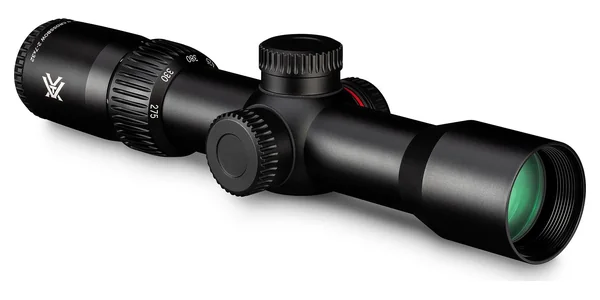
Vortex’s crossbow kit has the widest speed range here, 275 to 450 fps, which covers even very fast crossbows. Its XBR-2 reticle uses a 40-yard zero with holdover points from 20 to 100 yards and red or green illumination. The FPS setting is marked on the magnification ring. It has a 30 mm tube, weighs 14 oz and is 9.5 inches long.
It’s also the most complete package: two 30 mm rings, flip caps and a neoprene cover come in the box, so you don’t need to buy anything else. Vortex’s warranty is unlimited and unconditional. It had the most owner feedback of the four. It was sold by a third-party seller and shipped by Amazon.
4. Garmin Xero X1i: easiest to use
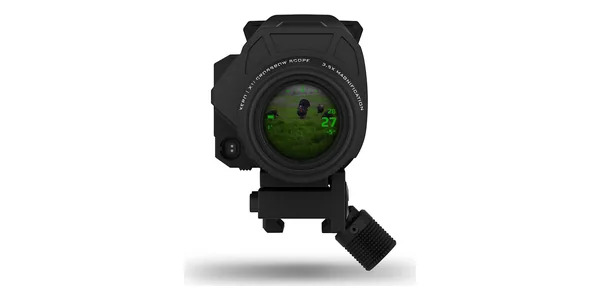
The Xero X1i takes the guesswork out of distance. Press a button and its built-in laser rangefinder measures the distance (up to 250 yards on game, with angle compensation), then lights up the right aiming point. Once you set a 20-yard aiming point, it can calibrate the rest out to 80 yards from your bow’s speed, though Garmin says you should confirm accuracy at 50 yards. It has 3.5x magnification, mounts directly on Picatinny or Weaver rails and runs on two AAA lithium batteries.
The trade-offs are weight and price. At 1.9 lb, it’s more than twice as heavy as the other scopes here. Electronic and rangefinding sights aren’t allowed everywhere, so check your state’s rules first. It was sold and shipped by Amazon.
The bottom line
A crossbow scope doesn’t need to be expensive. It needs aiming points that match your bow’s speed, enough light at dawn and dusk, and a mount that holds its zero. For most hunters, the Vortex Crossfire II kit is the one to buy. The Hawke XB1 does nearly as much for less, and the Hawke XB 3×32 is a good budget choice for bows near 340 fps. Buy the Garmin if you want the range measured for you and can live with the weight and cost.
Still choosing a crossbow? See our best crossbows guide, our TenPoint and Barnett reviews, or our guide to crossbow types and brands.